
ADC Develops Integrated Digital Infrastructure for Election Monitoring, Public Information and Nationwide Operational Coordination. The African Democratic Congress has developed the ADC Global Integrated Election Transmission System, known as GIETS, a comprehensive digital platform designed to transform the party’s approach to election monitoring, field coordination, information transmission and public access to election updates.
The technological development of the system has been completed, while training is currently underway for polling agents, verification officers, command-centre personnel and other authorized users who will operate the platform during elections.
Details of the official launch, including its date, location and activation arrangements, remain confidential. The party intends to unveil the system at what it considers the most strategically appropriate point in its electoral preparations.
GIETS has been conceived as more than a result-viewing application. It is an integrated election-management ecosystem connecting trained field agents, state command centres, a National Command and Control Centre in Abuja, public mobile applications, digital billboards, public information screens, international election observers and secure evidence-management facilities.
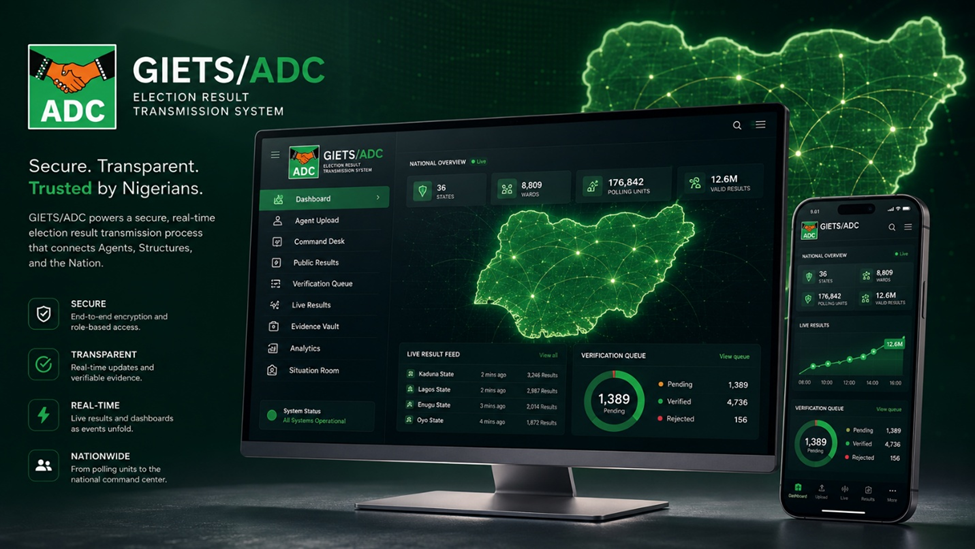
The ADC Global Integrated Election Transmission System brings election monitoring, public information and operational coordination into one digital ecosystem.
A Different Approach to Election Monitoring
Election-day activities take place simultaneously across thousands of polling units. Party agents, election officials, voters, observers, journalists, legal teams and security personnel may all require timely information from different parts of the country.
Traditionally, political parties have relied heavily on telephone calls, messaging groups, handwritten reports and separate communication channels to monitor developments. This can make it difficult to authenticate reports, preserve evidence, identify areas requiring intervention and maintain a complete national picture of events.
GIETS is designed to address that challenge by creating a structured flow of information from polling units to ward, local government, state and national election-management structures.
Authorized ADC agents will use a dedicated field application to submit reports, transmit copies of polling-unit documents, upload photographs and videos, record operational delays and report alleged irregularities or safety concerns.
Each submission will be connected to the identity and assigned location of the reporting agent. Reports may also carry timestamps and location information to help reviewers determine when and where they originated.
Where internet service is weak or temporarily unavailable, the field application is expected to retain completed reports securely and transmit them when connectivity is restored.
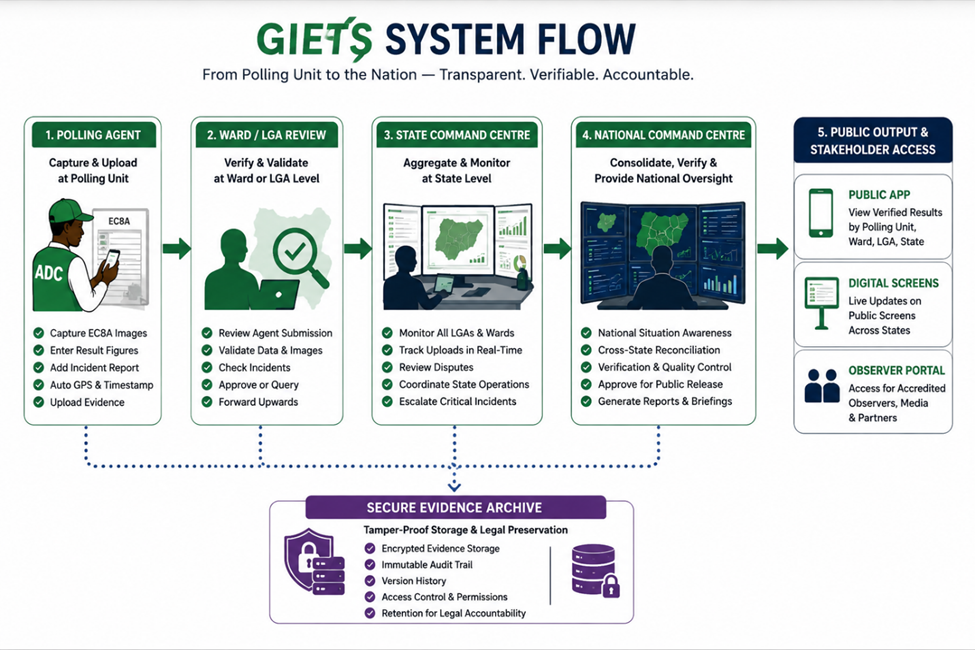
GIETS creates a controlled information flow from polling units through internal verification and authorized public channels.
A Dedicated Application for Trained Polling Agents
The first major component of the system is the GIETS Agent Operations Application, which will be used by trained and authorized ADC polling agents in the field.
Training for these personnel is already ongoing. Agents are being prepared to use the application for polling-unit check-in, structured reporting, result-document capture, incident reporting and the transmission of supporting evidence.
Through the application, an authorized agent will be able to confirm arrival at an assigned polling unit, report whether election officials and materials are present, document the commencement of accreditation and voting, and submit reports as activities progress.
The agent will also be able to photograph and transmit copies of result documents legitimately available to party representatives at the polling unit.
Where an incident occurs, the application will allow the agent to record what happened, state the time and location, attach photographs or videos and indicate whether urgent assistance is required.
This structured approach is intended to reduce dependence on fragmented telephone conversations and provide election managers with reports that can be reviewed, organized and preserved.
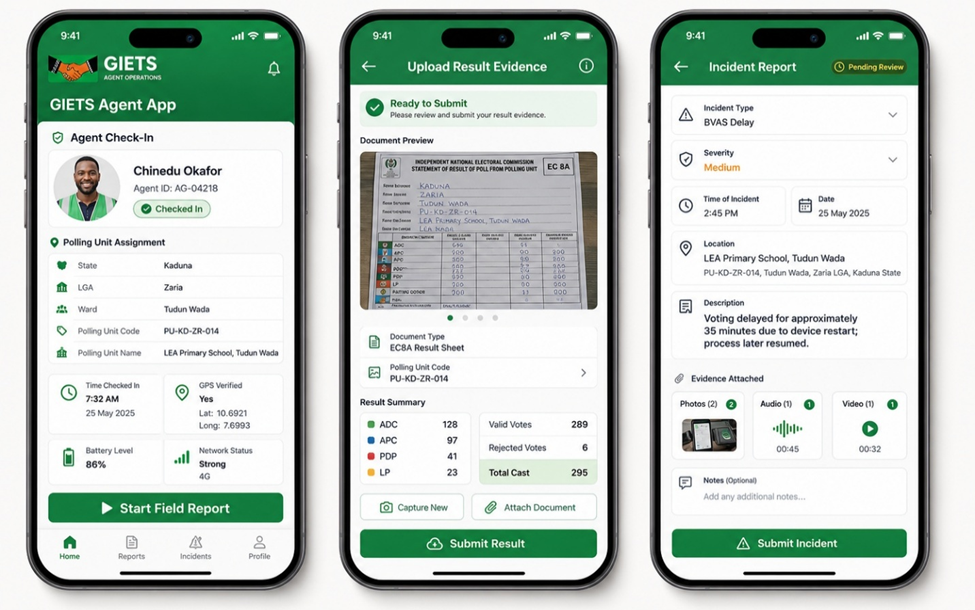
The GIETS Agent Operations Application enables trained field personnel to submit polling-unit reports, documents and multimedia evidence.
National and State Election Command Centres
At the centre of the GIETS operational structure will be a National Election Command and Control Centre in Abuja.
The National Command Centre will provide authorized election managers with a nationwide view of reports received through the system. Personnel at the centre will be able to monitor agent deployment, reporting progress, operational incidents, result-document submissions and locations requiring attention.
The centre will also coordinate communication with state structures, review nationally significant incidents, authorize appropriate public information and manage content transmitted to the GIETS public application and nationwide digital-screen network.
The national facility will be supported by State Election Command and Control Centres across Nigeria’s 36 states and the Federal Capital Territory.
Each state centre will receive and review information from local government areas, wards and polling units within its jurisdiction. Reports requiring further attention may be escalated to the National Command Centre in Abuja.
The operational structure will allow information to move from the polling-unit level through the appropriate review channels before it is approved for broader internal use or public display.
This verification process is essential because information will not automatically become verified merely because it has been uploaded.
Reviewers may examine the identity and assignment of the reporting agent, the time and location of the submission, the quality of attached documents, other reports received from the same area and any supporting photographs or videos.
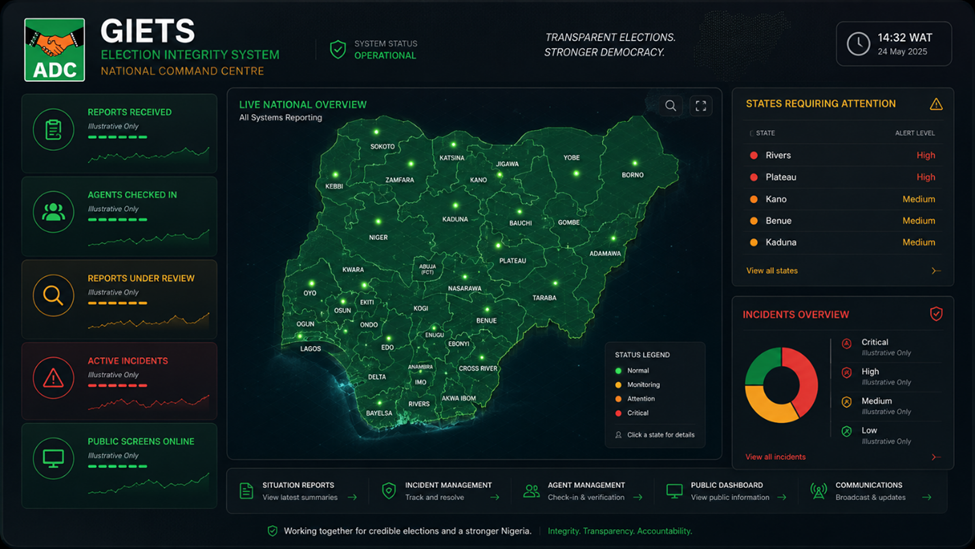
The National Command and Control Centre will provide authorized officials with a coordinated view of election operations across the country.
Giving the Public Direct Access to Election Updates
A major part of the GIETS project is a separate Public Election Information Application for citizens, journalists, civil society organizations, researchers and other interested users.
Through the public application, users will be able to choose the election they wish to follow and navigate through available information by state, local government area, ward and polling unit.
Users may also receive notifications when new polling-unit documents are published, when an important public advisory is issued, when a reported incident is under review or when previously published information has been corrected.
The public application is intended to function as an accessible mobile window into election developments. It will allow users within and outside Nigeria to follow authorized information without having to remain in front of a television or desktop computer.
The platform must, however, clearly distinguish among information that has merely been received, information under review, information internally verified by GIETS and results officially declared by the Independent National Electoral Commission.
GIETS is not intended to replace INEC, conduct official collation or independently declare winners. Where information is described as “GIETS-verified,” this will mean that ADC reviewers have confirmed its source and internal consistency. It will not mean that the information has been officially certified by INEC.
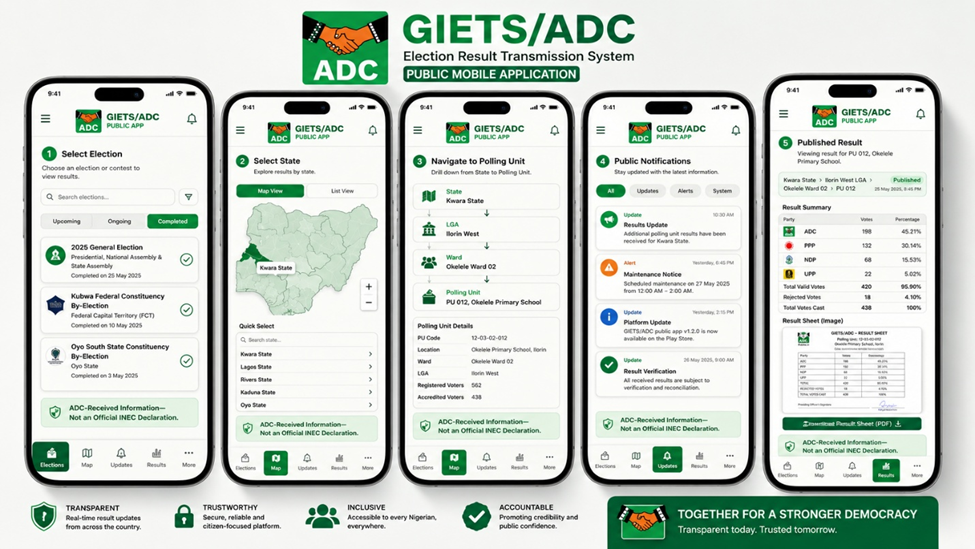
The public application will allow users to follow authorized election information and receive notifications on selected elections and locations.
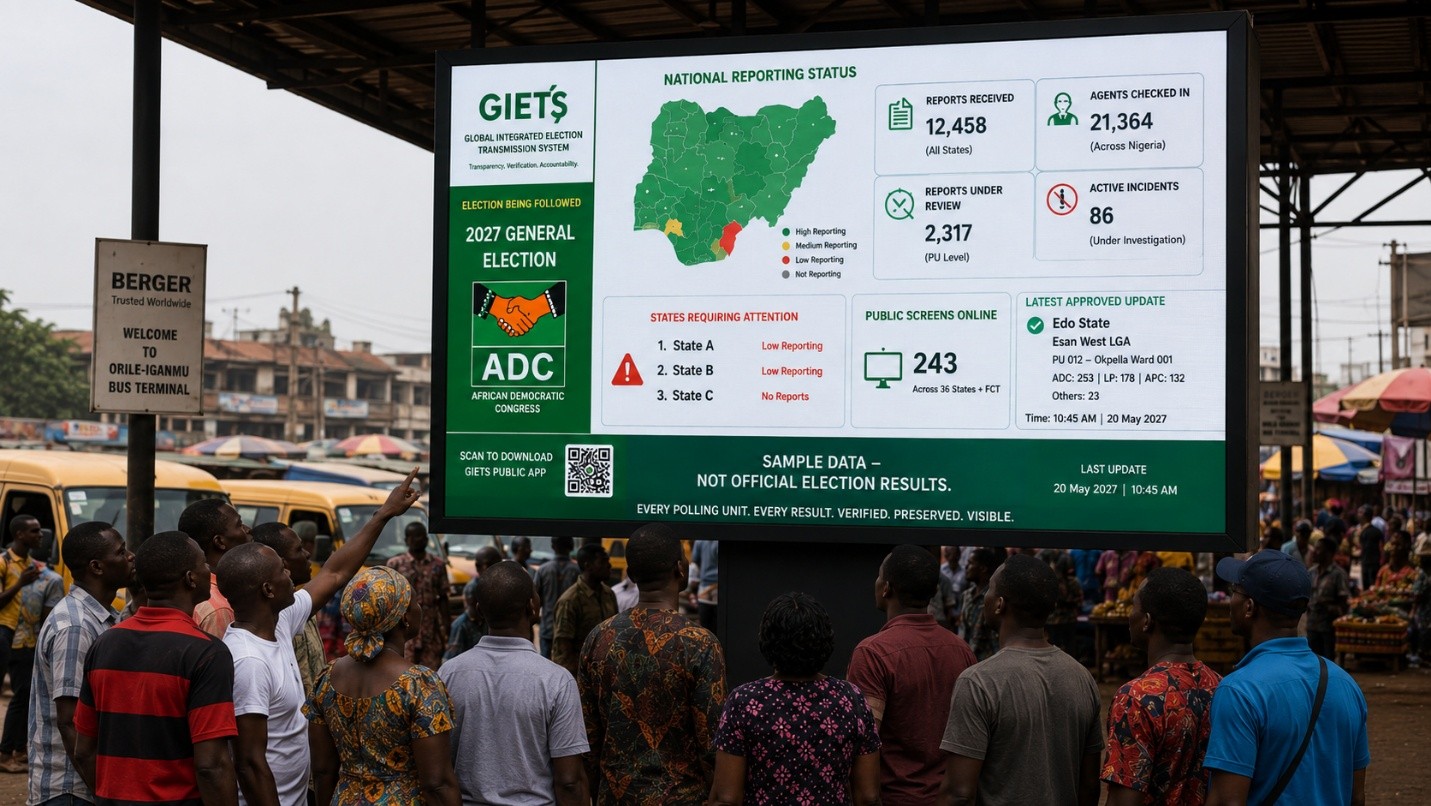
Bringing Election Information to Markets, Stations and Public Spaces
GIETS is also being developed as a public information infrastructure for people who may not own smartphones, have sufficient mobile data or possess reliable internet access.
The wider deployment plan includes connecting GIETS to participating digital billboards and public display systems in Abuja and other parts of Nigeria. The project will also involve the provision of additional digital screens and protected display enclosures at approved strategic locations.
These locations may include markets, motor parks, transport stations, civic centres, shopping areas, community facilities, educational institutions and other high-traffic public spaces.
The objective is to allow ordinary Nigerians—including traders, street vendors, artisans, transport workers, students and rural residents—to follow authorized election information as events unfold.
A person selling goods in a market or working at a transport station should not be excluded from access simply because that person cannot download an application or afford regular mobile data.
Approved information may be transmitted from the National Command Centre to the nationwide screen network. This may include reporting progress, result documents approved for public display, public-safety information, notices concerning delays, verified photographs or videos and corrections to previously displayed information.
Connections to existing private or commercial digital billboards will remain subject to appropriate agreements, technical compatibility and authorization.
Leave a reply
Recent Post






Comments (0)